 |
 |
With the arrival of summer, the TRAP project (Participatory strategies for managing plastic pollution along the transboundary coastline) reaches its halfway point. Taking advantage of this milestone in the calendar, we want to dedicate the beginning of this newsletter to taking stock of all the ground covered so far.
Many of you have taken part in the different phases of this project, and your involvement has been key to getting us where we are today. For this reason, below we present a highlight summary of the activities, lessons learned and results that we have achieved together over these months.
|
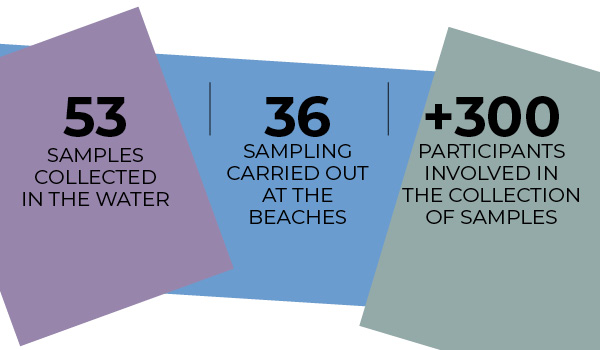
▶ Let’s do the numbers!
How are TRAP’s sampling campaigns going?
|
|
|
|
▶ What do we do with the samples
once they arrive at the laboratory?
|
Have you ever wondered what we do with the samples once they arrive at the laboratory?
Here’s the full story!
A sample’s journey from the coast to the data we work with follows a meticulous process divided into 5 stages:
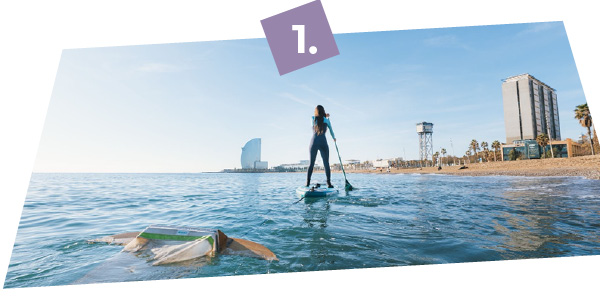
Arrival at the laboratory
As soon as the sample has been collected—whether by towing a net through the water or sampling on the sand—it is sent to the UB Faculty of Earth Sciences laboratory, where our team receives it and gets to work processing it.

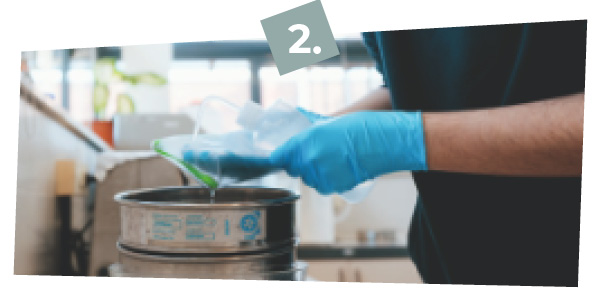
Pretreatment: deep cleaning
If the sample contains a lot of organic matter, such as algae or plankton, we apply a digestion treatment with hydrogen peroxide to clean it thoroughly and make the next step easier.
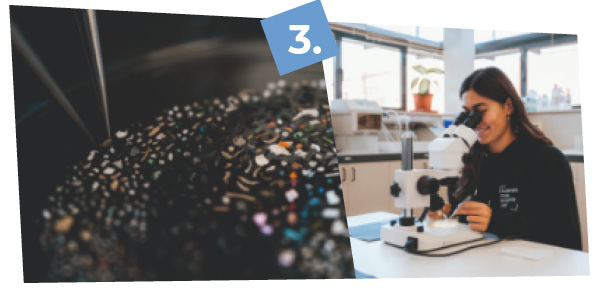
Microplastic extraction
With the sample properly cleaned, plastics are extracted one by one using high-precision tweezers under a binocular microscope at between 10x and 50x magnification. They are then placed on a Petri dish without touching each other—this is where the team’s artistic side comes out, as each person ends up creating a unique microplastic mosaic.
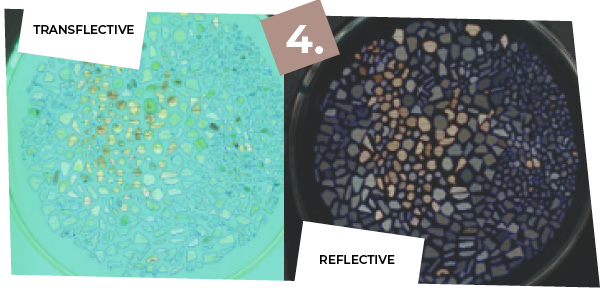
Scanning and image analysis
We scan the Petri dish twice: once with a black background and once with an illuminated green background, which highlights transparent particles. We then work with image-processing tools and use artificial intelligence to obtain the number of plastics, their size, area, shape (and origin), colour, and other key variables.
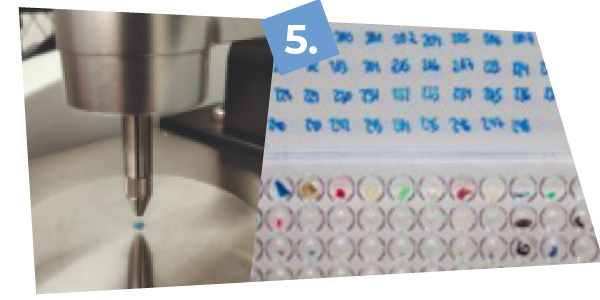
The plastic’s “DNA”
Finally, we chemically analyse a random selection of plastics to read their “DNA”: polyethylene, polypropylene, polystyrene, etc.
Thanks to this process, we can quantify the microplastics floating along our coasts. The size of the fragments provides information about their degree of degradation: the smaller they are, the more degraded they tend to be, but they are also more bioavailable (more easily absorbed by living organisms); by contrast, fragments of larger dimensions usually correspond to plastics released more recently into the marine environment.
Shape allows us to infer their origin:
- Films Fragmentation of plastic bags
- Fragments Derived from packaging, bottles or tyres
- Filaments Fishing gear or artificial grass
- Foams Degradation of food packaging
- Pellets or microbeads Raw material or cosmetics
Colour also provides relevant information about the length of time the plastic has remained in the environment: brighter tones indicate more recent plastics, while more yellowish or translucent colours suggest prolonged exposure on the ocean surface.
Finally, the type of polymer largely determines the plastic’s environmental fate. Materials such as polyethylene, polypropylene or expanded polystyrene, which are less dense than seawater, tend to float—unless they are colonised by organisms and eventually sink. In contrast, denser polymers such as polyester, PET, polyamide (nylon) or PVC are more likely to sink.
|
|
 |
|
▶ Major “Plastic Seekers” operation in Banyuls-sur-Mer
|
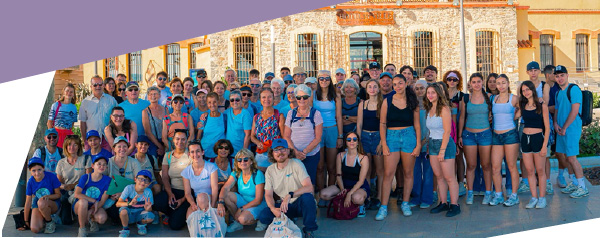
On 29 and 30 May 2026, Plastic at Sea, in collaboration with the Banyuls-sur-Mer town council, coordinated the “Plastic Seekers” operation במסגרת the TRAP project. Now an essential annual event, this initiative brings together residents and visitors for a methodical collection and sorting of waste on the main beach, along riverbanks and in several neighbourhoods of the town. Each piece of waste is identified and counted, and the data are integrated into databases to assess the evolution of pollution and the effectiveness of the mitigation measures implemented. This year, 73 people came together to fight plastic pollution. |
|
 |
|
▶ New publication:
Barcelona and plastic,
quantifying an invisible source
|
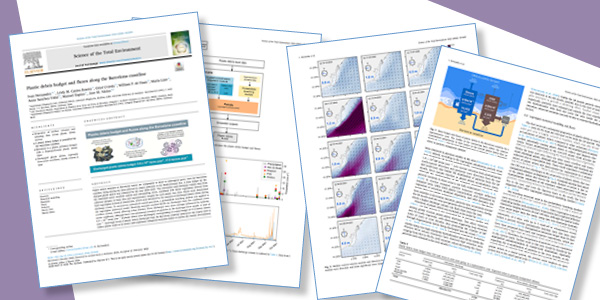
A new scientific article has been published in the journal Science of the Total Environment (you can read it in full here) analysing the amount of plastic waste that reaches the sea from different points along Barcelona’s urban coastline.
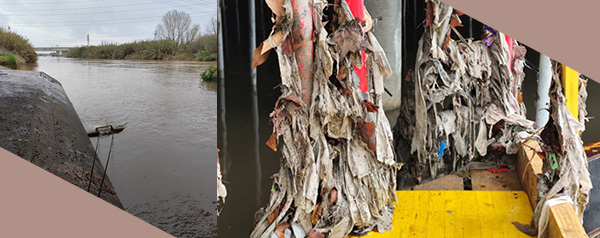
To do this, we cross-referenced discharge data from Barcelona’s urban storm overflows (systems that release sewer water into the sea during episodes of intense rainfall) and the flows of the Llobregat and Besòs rivers with the real samples collected from the Bogatell overflow and the Llobregat River. The results are clear and remind us of the importance of our work:
- A massive source of pollution. It is estimated that nearly 60 billion plastic particles reach the sea every year. Of these, the vast majority are microplastics: they account for 93% in rivers and up to 98% in urban storm overflows.
- ️ Tonnes of plastic every year. In terms of weight, the figures are also striking. Rivers contribute approximately 14.4 tonnes of plastic per year, while urban storm overflows add another 2.5 tonnes .
- ️The boomerang effect on our beaches. Thanks to numerical simulations, we analysed where this waste ends up once it reaches the sea. The result is surprising: more than 98% of waste from storm overflows returns to the coast, and 60% ends up being deposited on the nearest urban beaches.
- North and south: impact spread across the coast. The study shows that waste from the Llobregat River mainly affects beaches south of Barcelona, while waste from the Besòs more frequently impacts beaches to the north of the city.
- Small size, major impact. Although the Llobregat and Besòs contribute only 0.09% of the water entering the Mediterranean, plastic emissions from Barcelona’s coastline could account for up to 8.5% of the particles and 5.2% of the total mass reaching this sea.
|
 |
Citizen science works!
The samples obtained and analysed by TRAP volunteers, combined with numerical models, have been vital in revealing the map of plastic pollution in Barcelona. This shows that relatively small rivers crossing densely populated and industrialised areas can become major sources of pollution, and highlights the crucial importance of continuing to work on monitoring and mitigation. With your help, we keep moving forward!
|
|
 |
|
▶ Inspiring testimonials
|
For the TRAP project, we wanted to include in our participatory approach people who were not necessarily already involved in nature protection actions. The goal? To reach a broader audience, still not very aware of the issue of plastic pollution. For this reason, the project partners turned to volunteers from diverse backgrounds such as:
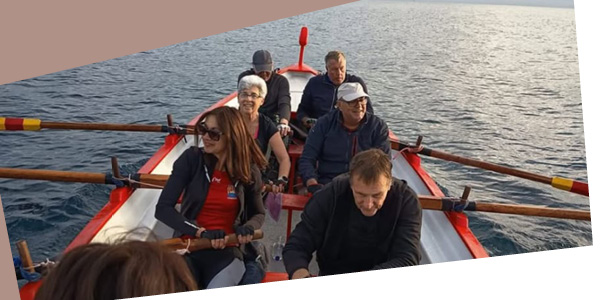
- Sports associations that carry out their activities in the marine environment and therefore have a special interest in protecting and understanding it, such as the Club Nàutic l’Escala or the rowers of Aviron Banyulenc.
- Third-sector social organisations such as APAJH of the Pyrénées-Orientales (ESAT les Micocouliers de Sorède), which defends the full citizenship of people with disabilities, who are also affected by this issue.
Below are some testimonials shared by participants in TRAP project clean-up actions:
“It is a wonderful opportunity that ESAT has given us to include the world of disability in the cause against plastic pollution for our planet. As a social-medical educator myself, I involve my son in waste collection every time we go diving, to the beach, to the forest or to the river. It is a moment for sharing, exchanging ideas and learning.” — Romain BATS, workshop instructor.
“A very beautiful experience; it feels great to work outside the walls of ESAT and, on top of that, for a good cause. I didn’t realise there was so much pollution on the beaches.” — Matéo.
“When I watch nature documentaries, it breaks my heart to hear about microplastics. This affects wildlife, plants and what we eat. I’m happy to work outdoors to help protect nature.” — Elodie.
“I’m happy to collaborate with the TRAP project partners. Including people with disabilities like me in this cause is wonderful. I think human beings are not very responsible with their environment, and that’s a shame. Unfortunately, we all suffer the consequences.” — Cédric.
|
|
|
▶ Remember to follow us on Instagram to stay up to date with the latest news!
▶ Want to know more or take part?
|
Stay tuned for upcoming editions of the newsletter!
Please send an email with the subject line “subscribe” or “unsubscribe” to hola@trap-poctefa.eu to subscribe to or unsubscribe from our newsletter. |
|